
St. Francis County Probate Court Records
St. Francis County Probate Court Records are kept at the County Clerk's office in Forrest City. The clerk serves as clerk to the probate division of the First Judicial Circuit and holds files for wills, estates, guardianships, and conservatorships. You can search St. Francis County probate cases online through the state CourtConnect portal, visit the clerk in person, or mail a copy request. This page walks through how to find a file, what a probate case holds, and how to get a plain or certified copy for your own use.
St. Francis County Probate Court Records Overview
St. Francis County Probate Court Records Office
The St. Francis County Circuit Clerk and County Clerk share duty over probate filings. The County Clerk serves as clerk to the probate court under § 28-1-106. Staff file papers, set hearing notices, and keep the case index. The main office sits at 313 South Izard Street in Forrest City. Hours are Monday through Friday, 8 a.m. to 4:30 p.m.
Call the clerk to ask about a case before you visit. Staff can pull the file and quote copy fees. Bring a photo ID. If you do not know the case number, bring the full name of the person who died and a rough year of death. The clerk will run the name through the probate index.
The office sits in the First Judicial Circuit, which also covers Cross, Lee, Monroe, Phillips, and Woodruff counties. Probate judges ride between these counties by rotation. All new estate cases, small estate affidavits, and guardianship petitions land here first.
Note: District courts in Forrest City do not have probate power. All wills, estates, and guardianship cases must go through the Circuit Court clerk's office.
Search St. Francis County Probate Court Records Online
The Arkansas Judiciary runs a free online case search at CourtConnect. Pick St. Francis from the county list. You can search by party name, case number, or case type. Probate cases show the party list, next hearing date, and each docket entry.
Most filings from the past 15 years are indexed. Older cases may be in paper only. The state search returns case summaries, not full document images. To see the will, the inventory, or the final accounting, you will still need to visit or mail the clerk.
The main case search front page is shown below.
The statewide portal is the fastest way to check case status.
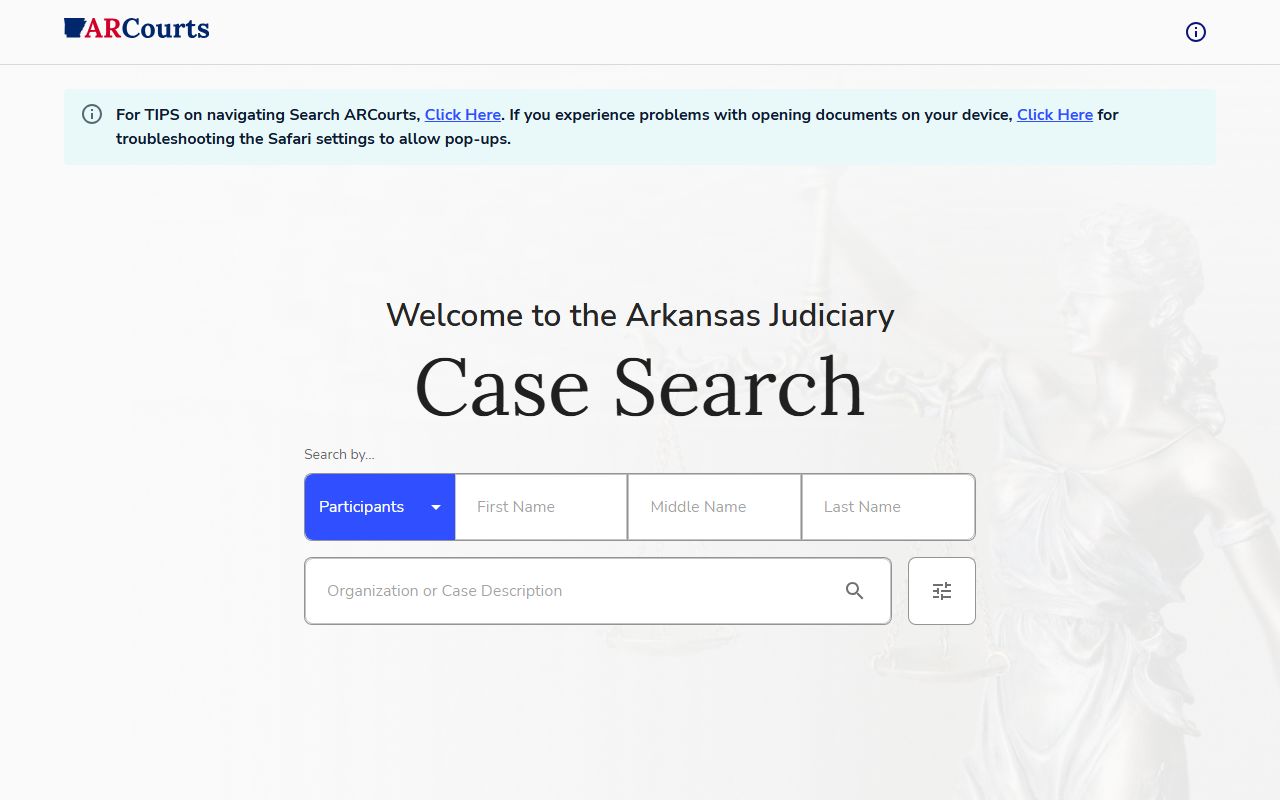
From the CourtConnect home page, pick the circuit and county, then run a search against the St. Francis County docket.
Types of St. Francis County Probate Court Records
The probate division of the Circuit Court hears a wide set of case types. Each file is its own public record, with a few narrow limits. St. Francis County Probate Court Records cover full estate cases, small estate affidavits, wills held for safekeeping, letters testamentary, letters of administration, guardianships, conservatorships, and adult name changes.
Each estate file starts with a petition. The court then enters an order admitting the will or opening the estate. The personal representative files an inventory of assets within 60 days under § 28-48-101. Creditor claims must be filed within six months of first published notice under § 28-40-111.
A standard St. Francis County probate case file holds:
- Petition for probate or administration
- The original will and proof of will
- Letters issued to the personal representative
- Inventory and appraisal of estate assets
- Creditor claims and responses
- Final accounting and order of discharge
Guardianship files hold medical statements, letters from the guardian ad litem, and yearly status reports. Adoption files sit apart and are sealed by law.
St. Francis County Probate Court Records Fees
The standard filing fee for a full probate case is $165. That covers the opening petition and the letters issued to the personal representative. A small estate affidavit under § 28-41-101 costs about $25 to $30. Small estate filings are open only to estates at or below $100,000 in value, not counting the homestead and family allowances.
Copy fees set by the St. Francis County Clerk follow the state schedule. Plain paper copies are $0.25 per page. Certified copies are $5 for the first page plus $0.50 to $1.00 for each page after. Letters testamentary come with the court seal and run $5 per set. Order extra certified copies up front. Each copy costs little, but a second trip costs far more in time.
Heirs who plan to close bank accounts, retitle a deed, or cash in a life policy often need three to five certified sets. The clerk can quote an exact total once the file is pulled.
Request St. Francis County Probate Court Records
You have three ways to get a copy from the clerk. Pick the one that matches your need. In person is fastest for urgent items. Mail works well for out-of-state heirs. Online search is free but gives limited detail.
In person: walk in to the clerk's office at 313 South Izard Street in Forrest City. Bring a photo ID and the case number if you have it. Staff will pull the file and copy the pages you want. Plain copies are often ready the same visit. Certified copies take a few more minutes for the seal.
By mail: write a short letter with the case name, case number, a self-addressed stamped envelope, and a check for the copy fees. The clerk will mail back the copies within a week or two. If you do not have the case number, give the full name of the person who died and a rough year of death.
Online: start at caseinfo.arcourts.gov to find the case on CourtConnect. For a deeper dig, the Arkansas Judiciary site has forms and court rules in PDF form.
Historic St. Francis County Probate Court Records
St. Francis County was formed in 1827 from parts of Phillips County. Probate records reach back to that period, with a few gaps from old courthouse fires. Loose papers from the 1800s and early 1900s are held off-site at the Arkansas State Archives in Little Rock.
Many pre-1970 wills and estate files for St. Francis County are on microfilm. Researchers can order reels through the Family History Library. The FamilySearch wiki lists the reel numbers and the time span for each one. You can view the films at no cost from any affiliate library.
Older probate packets may hold a will, letters of administration, inventories, appraisals, guardian bonds, and receipts from heirs. These packets are a strong source for family history work and for land title research.
Legal Framework for St. Francis County Probate Court Records
Arkansas Circuit Courts hold probate jurisdiction under § 28-1-104. District courts have no role. A will must be filed within five years of death under § 28-40-103. Two attesting witnesses are required to prove a will under § 28-40-117. Intestate succession follows § 28-9-203.
Public access to probate files comes from the Arkansas Freedom of Information Act and Administrative Order No. 19 from the Supreme Court. Anyone may view a probate file during office hours. Clerks may redact social security numbers, bank account numbers, and the names of minor children. Adoption files are sealed by statute.
You can read the full probate code at Justia's Arkansas Code Title 28. Guardianship rules live at § 28-65-101 through § 28-65-601. The 20-day notice for guardianship hearings sits at § 28-65-207.
Tip: Keep a log of every fee paid, every notice served, and every receipt gathered during a St. Francis County probate case; the final accounting will need them.
Legal Help in St. Francis County
Low-income heirs can call Legal Aid of Arkansas. The main intake line is statewide. Apply online at arlegalaid.org. Legal Aid helps with small estate affidavits, simple guardianships, and heirship issues when the case fits their rules.
For a full probate case with real estate or a contested will, a private attorney is a better fit. The Arkansas Bar Association runs a referral service. Many local lawyers take a short free first call to scope the case.
Nearby Arkansas Counties
St. Francis County sits in east Arkansas. Each neighbor files probate cases at its own county seat.